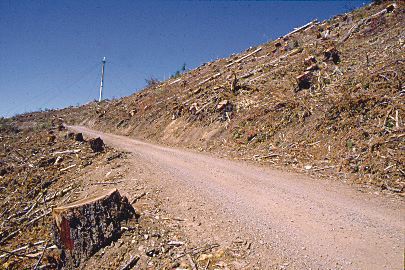
By 1905, when the Forest Service was formed, the timber industry had
shifted from the Great Lakes Region to the old growth forests of the Pacific
Northwest. One timber executive has argued that by their very nature,
timber communities were "never considered anything but tools to the
rescuing of the timber [sic] and would be discarded just like a worn-out hoe or
plow or any other piece of equipment whose purpose had been served."3 As Jude
White of International Paper reportedly said to forester Gordon
Robinson, "When we clean up the timber in the West, we'll return to New England,
where the industry began."4
A brief history of the US Forest Service in the NW
The national forests were off limits to logging, grazing and mining when
they were first established in 1891. It was not until 1897, due to
pressure from timber interests, that public lands were opened up to commercial
logging. For decades, logging levels in the National Forests were low,
only a few billion board feet per year nationwide. Early on the Forest
Service banned clearcutting on federal lands, insisting that loggers take only
mature trees and leave the smaller ones standing. The Forest Service
actually criticized the timber industry's destructive logging practices
on privately owned land.5 Yet, little was done by Congress or the Forest
Service to end the logging practices they had condemned.
The end of the 19th Century also saw one of the biggest public land
giveaways in U.S. history, with the federal government agreeing to allow
large railroads rights to use of huge tracts of federal lands for
development of transnational railways.
In their remarkably detailed book describing this historical action,
"Railroads and Clearcuts", Derrick Jensen, George Draffen, and Dr. John
Osborn, relate the following, "In 1864 President Lincoln signed into
law the largest of the railroad land grants, the Northern Pacific railroad land
grant. This law conditionally granted public lands for the purpose of
building and maintaining a railroad from Lake Superior to the Pacific
Ocean. The law gave public lands for a railroad right-of way upon which to lay
the tracks and 40 million acres (an area slightly smaller than Washington
state) to raise capital need to build and maintain the railroad. The land was
granted in alternating square miles, which created a "checkerboard"
pattern of ownership that is still visible on maps of many Pacific Northwest
forests."6
In 1870, after Northern Pacific failed to move ahead on the project,
Congress revised the grant. "Railroads and Clearcuts" explains, "If
Northern Pacific failed financially, then it was to sell the remaining grant
lands at local auction. In any case, all lands were to opened to homesteaders
within five years of completing the railroad. In 1873 and again 1893, Northern
Pacific failed financially, but the lands were never legitimately sold
at local auction, Ultimately, millions of acres of railroad forests would
pass from Northern Pacific to Weyerhaeuser and other corporations."
Most of this land fell to the chainsaw.
"Railroads and Clearcuts" describes how these millions of acres of
public lands were stolen by the railroad companies, destroyed through clearcut
logging and how we continue to this day to see a large amounts of these
"land-grant logs, cants, and wood chips bypass local mills and
opportunities for value-added industries" in the Pacific Northwest.7
Often, large corporations have built their empires, their profits and
their environmentally destructive legacy by buying illegally acquired public
property at land grab rates and destroying these lands through excessive
logging. These practices have imperiled hundreds of species of plants
and animals that rely on native forests for their survival.
Companies like Plum Creek Timber Company, Weyerhaeuser, Boise Cascade
and Champion International have liquidated millions of acres of forests in
the Pacific Northwest that rightly should have been publicly controlled.
Weyerhaeuser, alone, purchased 900,000 acres of Northern Pacific grant
lands in Washington state in 1899. The effect of the Northern Pacific land
grant was still being felt in the 1970s when Champion International bought
about 670,000 acres of these lands in Montana in 1972. After clearcutting most of this land, Champion sold it to Plum Creek
Timber Company in 1993.8 Conservationists continue to work to keep these lands
from being clearcut.
Corporate raiding of public lands did not begin to accelerate until
after the majority of privately-held lands had been devastated. After World
War II, a nationwide building boom and population growth led to an increased
demand for wood products. Timber companies were beginning to exhaust
the supply of virgin forests on private land, so logging was accelerated on
public forestland. Within a few years, the Forest Service caved in to
industry pressure to clearcut. By the 1960s clearcuts had become the
unofficial federal harvest policy. Many large private timber
corporations took advantage of this new public resource giveaway to milk millions in
profits by purchasing the rights to federal contracts for cutting publicly owned trees.9
A national Forest Practices Act was introduced by Senator Walter Pierce
of Oregon in 1941, Senator Frank Hook of Michigan in 1947, and by Senator
Clinton Anderson of New Mexico in 1949. All these bills would have
prohibited clearcutting and all were defeated.10 (Recently, bills to
stop clearcutting have been introduced in Congress. One bill would implement "zero-cut"--no commercial logging.
A court case brought by environmentalists in 1974 declared that,
according to the Organic Act, which created the National Forest system in 1891,
clearcutting was illegal on national forests. In response, the timber
industry lobbied Congress, which passed the National Forest Management
Act in 1976; the Act specifically legalized clearcutting.11
By 1983, some Forest Service officials concluded that federal forests
had been cut faster than they could regrow and a number of agency scientists
recommended lowering the cut. But, again, pressure from the logging
industry and pro-timber representatives in the Congress blocked that
recommendation.
Logging in the national forests reached a peak in the 1980s with a
record output of 13 billion board feet per year in the late 1980s.12 By 1990,
90% of the old-growth forests in Oregon and Washington were clearcut.
Conservationists win important legal issues
Environmental groups used the law to stop logging on public lands,
bringing regional and national lawsuits based on other environmental laws. The
most famous court case, the "Spotted Owl" decision, in 1991, shut down timber
sales in the national forests of Oregon and Washington because Judge
William Dwyer ruled that the Forest Service never created a plan to log ancient
forests that complied with environmental laws. And the level of logging
was driving the northern spotted owl and many other species to extinction.
From 1991 to 1995, timber sales on many Northwest federal forests were
greatly diminished. Some mills closed. People who lived in areas
dependent upon logging national forests blamed environmentalists. It was "owls
vs. loggers," or "jobs vs. the environment," a misleading notion that the
timber industry continues to promote. Over the last decade, as timber profits
have increased, far more jobs have been lost to automation and exports of raw
logs and unprocessed wood than to reduced logging levels.13
Coincidentally, jobs in the Pacific Northwest have also been "exported"
to the Southeastern U.S. "Railroads and Clearcuts" charts how the major
corporations reduced their mill capacities between 1978 and 1990, while
increasing capacities in the Southeast.14 Many jobs were also lost
with the continued export of raw logs overseas.
A typical old-growth sawmill is small and labor-intensive, requiring
nearly ten person-years-of work per million board feet of wood processed, and
resource-intensive, converting as little as half the wood in each tree
to lumber. Such mills were once scattered throughout the Pacific
Northwest in small towns. As more and more old growth has been cut on private and
federal lands, mills have become increasingly dependent on second
growth trees.
When the timber industry began building advanced-technology mills for
second-growth timber, the uniform sizes of second growth trees also made
more automation possible. So, second-growth mills tend to be large,
capital-intensive (five person-years per million board feet) and
resource efficient (turning 80% or more of a log to products).15
In the old-growth-to-second-growth transition, many old-growth mills
closed. Yet output remained about the same. However, the newer mills,
concentrated in larger towns, employed fewer people. Between 1977 and 1987, for
example, timber jobs declined by 15%, while timber production increased by 5%.16
The Clinton's administration's Option 9 plan re-opened much of the
Northwest's national forests to logging. Clinton's signing of the
so-called Salvage Logging Rider into law opened up thousands of acres of old
growth forest to logging. This rider also set aside all major environmental
laws that had required conservation of these prime habitats for threatened
and endangered species. Many of the wild places protected through legal
actions in the 1980s were lost to massive clearcutting resulting from Salvage
Logging Rider. Activists across the Pacific Northwest took to the
woods to protect old growth forests. In some instances their direct action was
successful in protecting large areas from the chainsaw.17
Despite these actions, controversy over mill closures continues to be
framed by the timber industry (and the media) as a "jobs vs. environment"
issue. It's been estimated that limits on timber cutting due to protecting old
growth have cost no more than 15,000 to 30,000 direct and indirect
jobs.18 In contrast, advances in technology cost a direct work force reduction
of 13,800 jobs from 1980 to 1988, while output grew by almost 20%.19 Since
cutting on private lands continues to rely heavily on clearcutting, the
result has been greater loss of habitat for salmon, bull trout and other
endangered species.
Thousands of jobs lost to log exports
With increased automation and at current harvest rates, economists
predicts that many timber jobs will disappear. Currently, only about 7% of Oregon
jobs directly depend upon timber.20
Raw log exports have a major influence on mills, and employment in the
entire industry. It's been estimated that a federal ban of private log
exports could possibly provide an additional three billion board feet a
year for domestic processing, creating more jobs.21 These jobs put money
into local economies, enhancing other economic sectors.
Until the early 1960s raw log exports were a small factor in the timber
economy. But today, about one out of every four trees cut in Oregon and
Washington are exported. Since 1988, U.S. log exports have been worth
more than $2 billion every year.22 One mill owner has said, "If a log is of
export quality, and is available to be exported, it will be exported.
It will not be available to a domestic mill."23 This is partially because
foreign firms have often been willing to pay much higher prices for these logs.
In 1989 Oregon voters passed a referendum, by a nine-to-one margin, calling for a prohibition on the export of raw logs from state lands. In 1990 the U.S. Congress approved this action and added to it a permanent extension of the existing prohibition of raw log exports from federal lands.
Throughout the Pacific Northwest it is still legal to export raw logs from lands owned by individuals and corporations. And, until 1993, federal policy actually encouraged raw log exports through tax breaks. These tax breaks totaled approximately $100 million.24
Since then, there have been a number of bills proposed in Congress to halt the export of logs from private lands. U.S. Rep. Peter DeFazio (D-OR) introduced bills in 1990 and 1994 to ban private log exports. These bills failed to pass. Other legislators have introduced bills to allow states to restrict private log exports, or to give capital gains tax breaks for private owners who sell their logs domestically.
Some have argued for tariffs on log exports. After British Columbia imposed a tax equal to the "export premium" - the difference in prices paid for exported and domestically processed logs - log exports were dramatically slowed.25 Between 1990 and 1994, while total timber harvest in the Northwest declined by 30% log exports from Oregon and Washington declined by nearly 50% as a result of three factors: weak overseas markets, higher prices paid by domestic mills, and restrictions on exports of unprocessed logs on public-owned land. The State of Washington still allows some export of unprocessed logs from state-owned lands.
However, in spite of the sharp drop in export volume and increasing demand from domestic processor, upwards of 25% of the region's timber harvest continues to be exported as unprocessed logs.26
Since 1990, the exportation of raw (unprocessed) logs from federal and state forests in the Pacific Northwest have been illegal; however, it is legal to export raw logs from lands owned by individuals and corporations. Weyerhaeuser, for example, reportedly exports one of every three logs cut from Pacific Northwest lands it owns. 27 And, until 1993, federal policy actually encouraged raw log exports through tax breaks.
Forest destruction continues worldwide
Worldwide, more than 60% of all forested lands have been cleared and four billion trees are cut yearly to produce paper alone. Removing trees through clearcutting results in soil erosion, loss of shade, water pollution, floods, loss of wildlife, and loss of human life. In addition, while living trees remove carbon dioxide - a major greenhouse gas - from the air, destroyed trees release the carbon dioxide stored in their tissues. Deforestation contributes to roughly 25% of global carbon dioxide emissions. 28
According to new findings released by Oregon State University scientists, Pacific Northwest old growth forests have the ability to absorb and store vast amounts of carbon dioxide. "It appears these older forests are more active and may be stronger carbon sinks (storehouses) than we thought," said Bill Winner, an OSU professor of botany and plant pathology. 29
Previous research has shown that clearcutting turns a forest from a carbon sink (absorber) to a carbon source contributing to carbon dioxide pollution. 30 Slashburning has also been shown to add significant amounts of carbon dioxide to the atmosphere.
Siberia, which holds more than one-half of the world's evergreen forests and one-fifth of all forested land, is being logged at the rate of 5 million acres a year. Once logged, this semi-frigid land turns to swamp and cannot be replanted. Thirty million people live in the forests, including 24 distinct indigenous groups. 31
About half of all tropical rainforests have already been cut down. Major landslides and erosion due to deforestation have occurred in Borneo, Brazil, Indonesia, Malaysia, Nepal, and Thailand. 32 Still more forest is degraded by roads and fragmentation. Forest fires have engulfed millions of huge areas of Brazil and Indonesia. It is estimated that forests in Brazil are so dry that 50% of these forestlands could burn in a catastrophic wildfire. 33
Current global deforestation is occurring at ten times the rate of reforestation. Replanting trees cannot bring back the lost animals, plants and nutrients that a healthy, diverse forest contains. 34
Valuable human cultures are being destroyed
Rainforests are proving to be a largely untapped source of medicines. One-fourth of the medicines used in the U.S. originated in the rainforest. Rainforest products include products used for the treatment of leukemia, Hodgkins's disease, malaria, heart disease, birth control, and malaria. In many cases, rainforests are being destroyed before scientists can even document the unknown species they contain.
As rainforests are destroyed, indigenous peoples are forced from their forest homelands. This tragedy is occurring across the globe. For many, their future existence is in doubt.
As we lose these cultures that have survived for thousands of years, we lose their priceless knowledge and wisdom. Jerry Mander states in his landmark book, In the Absence of the Sacred, "Elsewhere in the world, millions of native people also live in the traditional manner, while suffering varying degrees of impact from the expansion of Western technological society. In places such as Indonesia, Borneo, New Guinea, the Amazon forests, the north of Canada, and even Scandinavia, the Soviet Union, China, and Tibet, tribal peoples are struggling to defend their ancestral places. 35
References and notes
1 D. Jensen and G. Draffan, Railroads and Clearcuts: Legacy of Congress's 1864 Northern Pacific Railroad Land Grant, Keokee Co. Publishing, Inc., 1995, p. 65. back
2 Ibid., p. 66. back
3 Ibid., p. 65. back
4 Charles E. Twining, Phil Weyerhaeuser: Lunberman, University of Washington Press, 1985. back
5 Save America's Forests, Washington, D.C., no date. back
6 Jensen and Draffan, 1995, p. 3. back
7 Ibid., p. 5. back
8 Ibid., p. 28. back
9 Paul Roberts, "The Federal Chainsaw Massacre," in Harpers, June 1997, p. 44. back
10 Bill Oberteuffer's article, "All Age, Multiple Species Forest Management," is a summary of issues related to public policy related to forestry practices and his award-winning work exploring hands-on ecoforestry work in Eastern Oregon. back
11 Ibid. back
12 information from Save America's Forests. back
13 Chad Hanson and Carl Pope, "Who's Radical? That's Easy: Timber Barons," and op-ed article in The Register-Guard, May 7, 1996. back
14 Jensen and Draffan, 1995, p. 66. These figures are based on data from H. Michael Anderson and Jefferey T. Olsen, "Federal forests and the economic base of the Pacific Northwest: a study of regional transitions," The Wilderness Society, Washington, D.C., September 1991. back
15 see "Forests in Distress," a series of articles in The Oregonian by Kathie Durbin and Paul Koberstein, October 15, 1990. back
16 H.M. Anderson and J. Olson, "Federal Forests and the Economic Base of the Pacific Northwest: a Study of Regional Transitions," The Wilderness Society, Washington, D.C., 1991. back
17 Kathie Durbin, Tree Huggers, published by the Mountaineers, 1996, pp. 265-289. back
18 Paul Roberts, Harper's, p. 48. back
19 Oregon State Department of Employment, 1996. back
20 see "Economic Conditions in Pacific Northwest Log markets: Current Status and Prospects For Change," D. Brooks, USDA Forest Service and J. Garcia, University of Washington. back
21 Jensen and Draffan, 1995, pp. 73-74. back
22 Ibid. back
23 Ibid. back
24 Ibid., pp. 84-85. back
25 H. Michael Anderson and Jeffrey T. Olson, "Federal Forests and the Economic Base of the Pacific Northwest: a Study of Regional Transitions," The Wilderness Society, Washington, D.C., 1991. back
26 Jensen and Draffan, 1995, p. 73. back
27 Ibid., p. 75. back
28Geoffrey Saign, Green Essentials: What You Need to Know About the Environment, Mercury House, San Francisco, 1994. back
29 Lance Robertson, "Big Trees may offset warming of Earth," The Eugene Register-Guard, December 10, 1997, p. B1. back
30Ibid., p. 5. back
31 Geoffrey Saign, pp. 59-60. back
32 Ibid. back
33 Todd Lewan, "Much of Amazon ripe for catastrophic wildfires," The Register-Guard, December 4, 1997, p. A1. back
34 Geoffrey Saign, p. 62. back
35 Jerry Mander, In the Absence of the Sacred, Sierra Club Books, 1991, pp. 5-6. back
Table of Contents
Chapter 2 Intro/Chapter 2.1/Chapter 2.2/Chapter 2.3/Chapter 2.4
Copyright (c) 1997-98 OLIFE -- Oregonians for Labor Intensive Forest Economics. All rights reserved.